
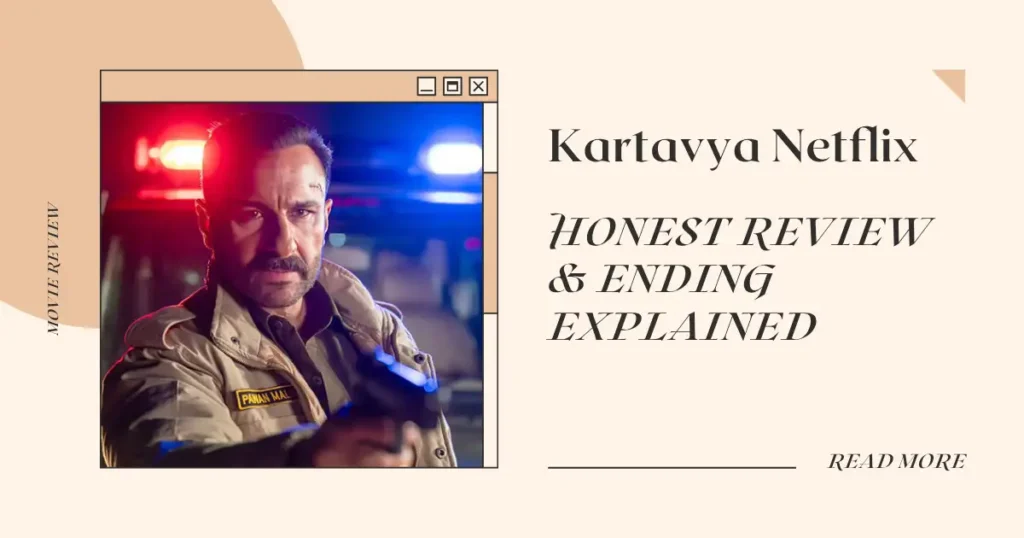
Hey friends, it’s Sushant Chauhan here. Last weekend, I was scrolling Netflix at midnight, craving something gritty after a long day. I clicked on Kartavya because Saif Ali Khan in a cop uniform? Sign me up. Two hours later, I sat there staring at the credits, feeling… mixed. The movie has heart, real social fire, and Saif carrying the whole thing on his shoulders. But it also left me frustrated – like it started a big conversation about duty, caste, and corruption, then quietly walked away before things got too messy.
If you’re here because the plot felt confusing, the twists predictable, or you’re wondering if it’s worth your precious Netflix hours (especially with that “honor killing” buzz), this honest cinematic movie review and explanation is for you. No spoilers in the first half – I promise. I’ll break down the story simply, the acting, the direction, and then dive deep into the ending explained section. Let’s get into it like we’re chatting over chai.
The Honest Breakdown: Acting, Direction, and Vibe
Straight up, Kartavya is a crime thriller set in the fictional Haryana town of Jhamli. Director Pulkit (who also made Bhakshak) clearly wanted to shine a light on real North Indian issues – missing kids, powerful godmen, caste violence, and cops caught between duty and family. The YouTube reviewer Yogi nailed it when he said the concept felt a bit “faded” if you’ve binged too many crime dramas. But it still has bite.
Saif Ali Khan steals the show. This is hands-down his strongest performance in years. As SHO Pawan (or Pawan Malik in some references), he doesn’t play a flashy “hero cop.” You see the weight on his shoulders – the quiet anger, the exhaustion of fighting a rotten system, and yes, his human flaws. Remember his intense vibe in Sacred Games? This feels like a grounded cousin. Saif’s face does the heavy lifting: one look and you feel his inner battle between badge and blood.
The supporting cast is solid but uneven. Yudhvir Ahlawat (playing the young Harpal) absolutely shines. He’s the kid crushed under pressure, fear, and manipulation – his scenes hit you in the gut with raw emotion. Sanjay Mishra brings his usual presence as a colleague, but his role feels undercooked. Rasika Duggal? She leaves a mark in limited screen time, which shows how talented she is. But the biggest letdown is the villain – Baba Anand Shri, played by Saurabh Dwivedi. The script builds him up as this shadowy, dangerous figure running an ashram full of dark secrets. On screen? He feels more like a generic bad guy than a truly terrifying force. No chill down your spine. No real menace. That’s a missed opportunity.
Direction and technical stuff: Pulkit keeps the film moving at a brisk pace – under two hours, thank god. No boring stretches. Things keep happening, which Yogi called out as a big plus. Dialogues have that authentic Haryanvi flavor without overdoing it. Background score stays out of the way, letting the story breathe.
But here’s where it stings: the visuals. The story screams for dusty roads, tense villages, and that raw, uncomfortable Haryana grit. Instead, everything looks a bit too clean and polished, like a glossy TV serial. The fear, the dirt, the helplessness – it doesn’t hit you as hard as it should. You feel the intention, but the execution pulls punches.
What’s Kartavya Really About?
No heavy spoilers yet. The story kicks off with an honest cop, Pawan, who treats his uniform like a real responsibility – not just a job. A journalist arrives in Jhamli, digging into the powerful Baba Anand Shri and his ashram. She’s exposing ugly truths about missing children and exploitation. Before she can blow the lid off, she’s murdered right under Pawan’s watch.
From there, the web unravels fast: missing kids, honor killings, caste politics, and the scary grip of power. At home, Pawan’s world explodes when his younger brother crosses societal lines with an inter-caste marriage. Suddenly, Pawan isn’t just fighting criminals – he’s torn between family loyalty, his police duty, and standing up for the truth.
The film keeps asking one big question: What is a man’s real kartavya (duty)? Is it protecting your family at all costs? Following orders on the job? Or having the guts to call out the system even when it costs you everything? These themes are strong and relevant, especially in parts of India where caste and “honor” still destroy lives. But as Yogi said in his review, the storytelling sometimes feels basic. Twists you see coming a mile away. The thriller tension builds… then fizzles.
Kartavya Ending Explained: What Really Happened (Spoiler Warning – Stop Here If You Haven’t Watched!)
Major spoilers ahead. If you haven’t seen Kartavya, bookmark this and come back after. This section is where I explain the hidden intentions behind the climax and why it feels both powerful and frustrating.
The journalist (Reema) was under Pawan’s protection while investigating Baba Anand Shri’s ashram – Anand Bhoomi – where young boys were being exploited and going missing. She gets killed early, and Pawan is given just seven days to crack the case.
Parallel to this, Pawan’s younger brother Deepak elopes and marries Preeti from another caste. Their father, Harihar, along with villagers, pushes for an “honor killing.” This isn’t side drama – it crashes right into Pawan’s cop life.
The big twist? Pawan’s colleague, Ashok (Sanjay Mishra), is the traitor working for the godman. He manipulates events from inside the force. The young Harpal (Yudhvir Ahlawat) – a boy from the ashram who’s been abused and brainwashed – is the one who actually pulls the trigger on the journalist. He’s a victim turned weapon.
In the climax, everything collides. The brother’s inter-caste marriage ends tragically – Deepak and Preeti are killed off-screen in the honor killing by their own father and the mob. Pawan confronts the betrayal: he kills the traitor cop Ashok in a raw, emotional showdown. Then, in one of the film’s darkest moments, Pawan turns on his own father, Harihar, and shoots him too. It’s brutal – a man choosing justice over blood.
Pawan ends up filing an FIR against Baba Anand Shri, hinting that the godman’s empire will finally crumble. But the movie doesn’t show the full takedown. It’s bleak, open-ended, and leaves you feeling the weight of compromise. Pawan wins some battles but loses his family. He upholds his duty to truth… at a horrifying personal cost.
Director Pulkit’s hidden intentions: He wanted to show that “duty” isn’t black-and-white. In real life, cops, families, and society are all tangled in the same mess. The safe, predictable choices in the writing? I think Pulkit held back to keep it watchable on a big platform like Netflix. He raises the mirror to honor killings, caste pressure, and godmen exploiting the vulnerable – issues that still make headlines in Haryana and Uttar Pradesh. But by making the villain surface-level and the climax a bit rushed, the full rage and horror don’t land as hard as they could. It’s like the film whispers “this is wrong” instead of screaming it. That’s why it feels like it pulls punches right when it should go for the throat.
Yogi was spot on about the climax feeling weak. Saurabh Dwivedi’s character just… fades. You expect a bigger confrontation, but it never fully delivers. Still, Saif’s final scenes – that mix of exhaustion, anger, and quiet resolve – make you feel the cost.
Pros & Cons of Kartavya on Netflix
Pros:
- Saif Ali Khan at his intense best – nuanced, vulnerable, and powerful.
- Fast-paced (under 2 hours) and never boring.
- Boldly tackles real issues: honor killings, caste discrimination, police corruption, and child exploitation.
- Yudhvir Ahlawat’s emotional performance as the manipulated boy steals scenes.
- Authentic Haryanvi dialogues and a subtle background score.
Cons:
- Villain (Baba Anand Shri) feels underdeveloped and not scary enough.
- Story becomes predictable – many viewers (including me) guess the twists early.
- Visuals too clean and shiny for such a dark, gritty tale.
- Writing touches big topics but doesn’t dive deep into any one.
- Climax feels rushed; some threads (like the full godman takedown) are left hanging.
- Side characters come and go without enough impact.
Final Verdict & Rating: Watch or Skip?
Kartavya is not a bad film at all. It’s an above-average crime thriller with strong performances and important things to say. Saif carries it like a pro, and those emotional punches (especially around family and duty) stay with you. If you’re in the mood for a character-driven cop drama that mixes social commentary with thrills, give it a shot. Families can watch too – just a few minor swear words, nothing too extreme.
But if you want edge-of-your-seat suspense, shocking twists, or a fully fleshed-out villain, you might feel a bit let down. It raises the right questions but doesn’t always deliver the fearless answers.
My rating: 3 out of 5 stars (or 6.5/10). Solid watch for Saif fans or anyone interested in real Indian social issues wrapped in a thriller package. It won’t blow your mind, but it won’t waste your time either.
What did you think of Kartavya? Did the ending hit you the same way? Drop your thoughts in the comments – let’s discuss! If you want more honest reviews of Netflix thrillers, hit that follow button. I’ll be back soon with the next one.
Stay curious, stay honest, Sushant Chauhan
FAQs
Q: Is Kartavya hit or flop?
A: Honestly, Kartavya is neither a massive hit nor a complete flop. It’s more like a “solid middle” kind of film on Netflix. Saif Ali Khan’s performance is getting a lot of love — many people are calling it one of his best in recent years. But the overall movie has mixed reviews. Some are praising the bold topics and fast pace, while others feel it’s too predictable and could have been much sharper.
In my opinion, it’s a respectable success for an OTT release because it’s getting decent conversations and views, but it’s not breaking any major records. If you’re a Saif fan, you’ll enjoy it. For everyone else, it’s a one-time watch.
Q: What’s No. 1 on Netflix right now?
A: Right now (as of mid-May 2026), the No. 1 movie on Netflix is Swapped — an animated film that’s doing crazy numbers, especially with families and kids. It crossed 38 million views in its first week!
If you’re in the mood for something completely different from Kartavya, give Swapped a try. But if you want a serious crime thriller like this one, Kartavya is still sitting comfortably in the top charts.
Q: Which movie is Saif Ali Khan in 2026?
A: In 2026, Saif Ali Khan has already released Kartavya (May 15 on Netflix). Apart from that, he has a couple more films lined up — Haiwaan and Hum Hindustani are in the works, but their exact release dates are not confirmed yet.
Right now, Kartavya is the only Saif Ali Khan movie you can watch in 2026. And trust me, his role as the honest but troubled cop Pawan is worth checking out.